

Packrafter Waste Management: What to Doo with your packrafter poo...
So you’re a packrafter planning your first expedition or multi-day adventure on the river. You’ve dug cat holes before, and probably even used a wag bag. But packrafter poo management is different depending on the river corridor you are on. So how do you deal with your packrafter poo? Story by Thad Ferrell. Illustrations by by Jeremie Lamart & Rocky Mounts. Photos courtesy of Buddy Boy Adventure Waste Kits.
A Cautionary Tale of how not to poo in the wood
**Names changed to protect the guilty and innocent.**
Way out west there was once a fella, a fella I want to tell you about, a fella by the name of Vlad. Vlad was on his second season working as a fly fishing guide on the Big River River (BRR). Now he was no rookie, but let’s just say he was not as salty as he would eventually become over the seasons ahead. Vlad met his client, Donny, at the Fly Shop and drove to the put-in on the BRR. As they drove, Vlad talked of current fishing conditions and was genuinely excited, per usual, to get these guys on fish.
After rigging and dumping the boat, Vlad told him they had a little housekeeping to do before they launched. Housekeeping refers to a river safety speech, description of float, and the big one… what to do if you need to go to the bathroom. Donny was attentive for the most part, glazed over a bit toward the end, but did nod affirmative when asked about the WAG bag. He assured Vlad he was good to go and ready to get fishing. Awesome.
Fish were caught, a lot of fish were missed. And sometime after lunch Donny, who was in the back of the boat, tapped Vlad on the shoulder informing him he needed to make a pit stop.
“Do you need to poop?” Vlad asked.
A curt “yes” was all Vlad got back from the stern.
Vlad made his way cross current to a stand of thick willows to give Donny some privacy. After anchoring up, Vlad grabbed a new WAG bag and another ziplock bag with extra TP and hand sanitizer. And with that, Donny quickly disappeared into the willows. So Vlad hopped back in the boat and began untangling a line and leader. No sooner had he begun than Donny reappeared with one bag in hand, the one with xtra TP and hand sanitizer. Vlad was suspicious… 🤔
To Be continued (soon)…
Packrafter Waste Management: The WAG Bag & Other Methods
If you go outside, you’ll eventually have to “go” outside. Packrafter’s waste (aka packrafter poo) creates a substantial impact on all environments, but especially on fragile outdoor ecosystems such as the desert, high alpine tundra, and the river corridors that run through them, such as those in the Southwest. Mismanaged waste is unsanitary, spreads disease, and precipitates the destruction and degradation of the beautiful areas we love to play in. This article focuses on human waste, specifically human fecal matter, aka Poo, and not the “Bear of Very Little Brain” in the Hundred Acre Wood, but shit.
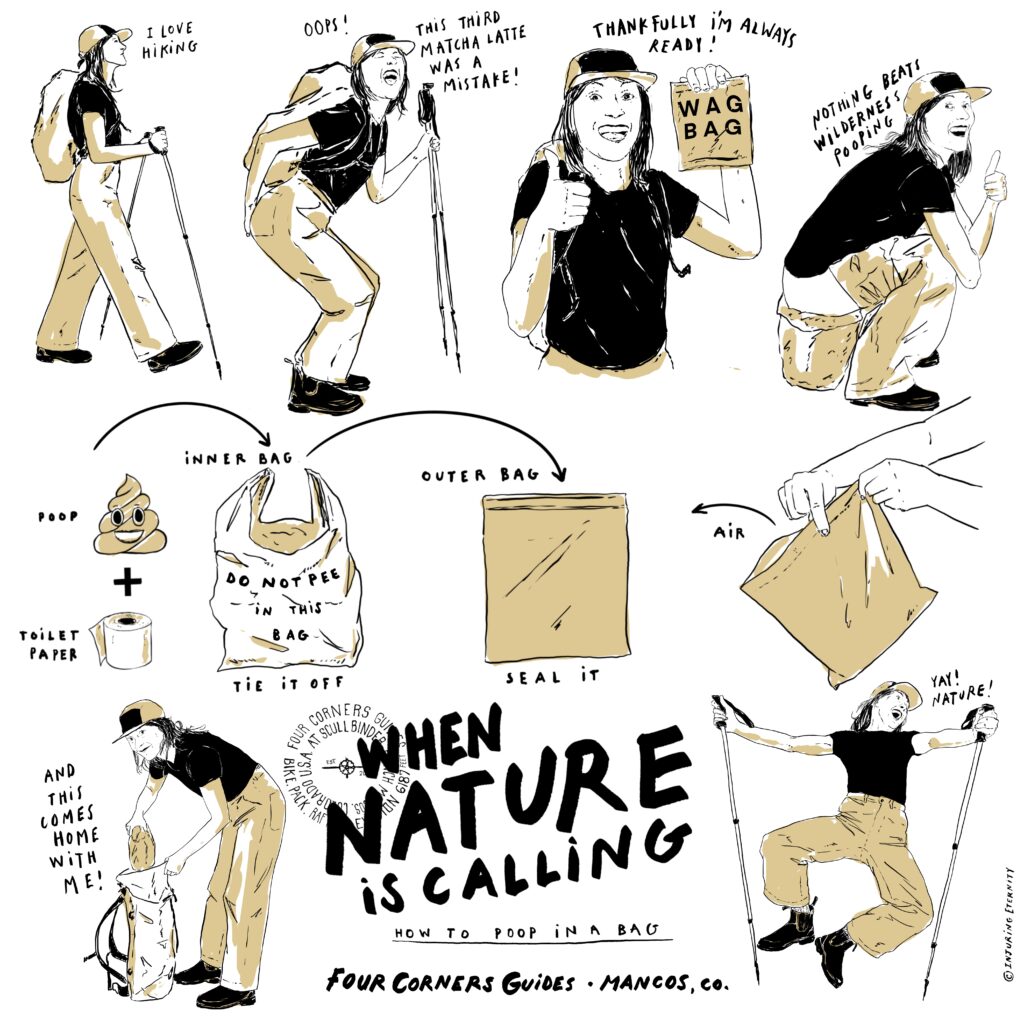
The best practice for packrafters to deal with our waste is to pack it out. Sounds like a big ask? Nah. It’s no big deal if you manage it correctly. And lucky for us there’s a handy invention called the WAG Bag. WAG is an acronym for “Waste Aggregation and Gelling” or “Waste Alleviating Gel.” But what this “Poo powder” does is the important piece to keep in mind; it turns fecal matter into a gel whilst minimizing odor and turning your waste into a tidy little package to pack out of the woods and dispose of properly when you get back to “civilization.”
The details are literally on the outer bag of the WAG. But, in a nutshell, there’s a large mat style plastic bag which is your target (really hard to miss, for most…), plus another bag which you can seal for transport, and usually a cleaning towelette and a bit of toilet paper. I suggest bringing extra TP and hand sanitizer in a separate sealable bag.
Pretty simple… do your business on plastic mat, fold and purge air, and then seal in transport bag. Depending on where your trip takes place, in particular on a multi day river trip, might necessitate a hard sided container to hold multiple WAG bags for transport. There are other methods and systems for bigger trips on the river, for instance the groover, or poop tube. WAG bags are simple, cost effective, and check the big box of… what you brought with you leaves with you.
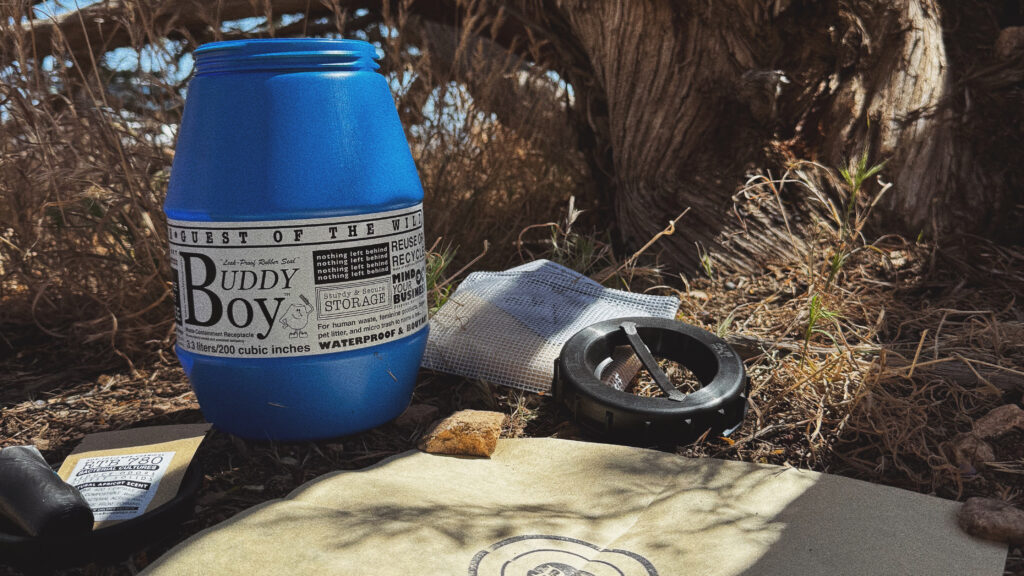
Longer multi day river trips in the packraft will require some sort of hard-sided container to store multiple used WAG bags. Sometimes the law requires these hard-sided containers on specific river corridors, such as the Grand Canyon. But I also strongly suggest you use one regardless because the last thing you really want is an exploded WAG bag in your gear. Quite a few companies offer hard-sided containers.
The Clean Waste Toilet in a Can and the Imlay Canyon Keg are two that I have used personally and do suggest. One can also make a solid poop tube out of PVC pipe. And there are a number of instructional how-to videos on good ole YouTube. Another option is the newer company, Buddy Boy Adventure Waste Kit (we’ll do a separate review on that system in a future blog post). WAG bags are simple, cost effective, and check the big box of… “what you brought with you leaves with you.” Regardless of the container option you chose it is imperative to purge the air out of your WAG to maximize space in the container. And, of course, this is best done right after using the WAG bag.👃🏼🤢
So where did Donny go wrong???
Part III - A cautionary tale continued...
“Huh” Vlad thought to himself, as he made an excuse to head into the willows. Not far into the thicket all of his suspicions were confirmed. There, in all its glory, was a man-sized turd with a cherry of TP on top. It sat on top of a completely intact and unopened WAG bag. A turd coaster? Some new fangled turd dehydrator that harnesses the power of the sun and evaporates human waste… Nope just the handy work of someone who doesn’t know shit.
Vlad made his way back to the boat in complete awe of what a lifetime of breathing out of your mouth could do to a person’s intelligence and then quietly informed Donny that he needed a redo on number two. Now it would be a lie to say the faintest spark of joy did not come into Vlad’s head from the thought of Donny picking up his own poo like a dog owner picking up after his canine friend with another wag bag. Luckily, George seemed amused as well. Needless to say, it was pretty quiet in the back of the boat the rest of the afternoon.
Packrafter Waste Management: The Cat Hole
And if you don’t have a WAG bag… A second best practice for disposing of human waste is the Cat Hole. A Cat Hole is a 6”-8” self dug hole that is a minimum of 200 feet from a water source and or camp. And, of course, deeper and farther are better in regards to the Cat Hole. If people come back in five minutes, they didn’t go far enough. We know it’s a shitty job, but the trip leader or guide needs to both teach their less-informed students or friends at the beginning of every trip and remind them throughout the trip about how to manage human waste.
And you can help by bringing lightweight plastic or metal shovels, an awesome addition to the Poo kit. Mine lives with my extra TP and hand sanitizer inside a waterproof bag. Best practice for used toilet paper is to pack it out with you. Burying and burning or just burying TP is not the best practice and not ideal for obvious reasons. Highly trafficked camps and fragile climate zones really highlight why Cat Holes are a solid second place in LNT practice. Fragile desert environments don’t have the biomass to break down fecal matter. And even twenty five cat holes around a backcountry camp is a lot.
Go out and have fun out there and hopefully these practices will help keep all of us from loving our favorite places to death.
